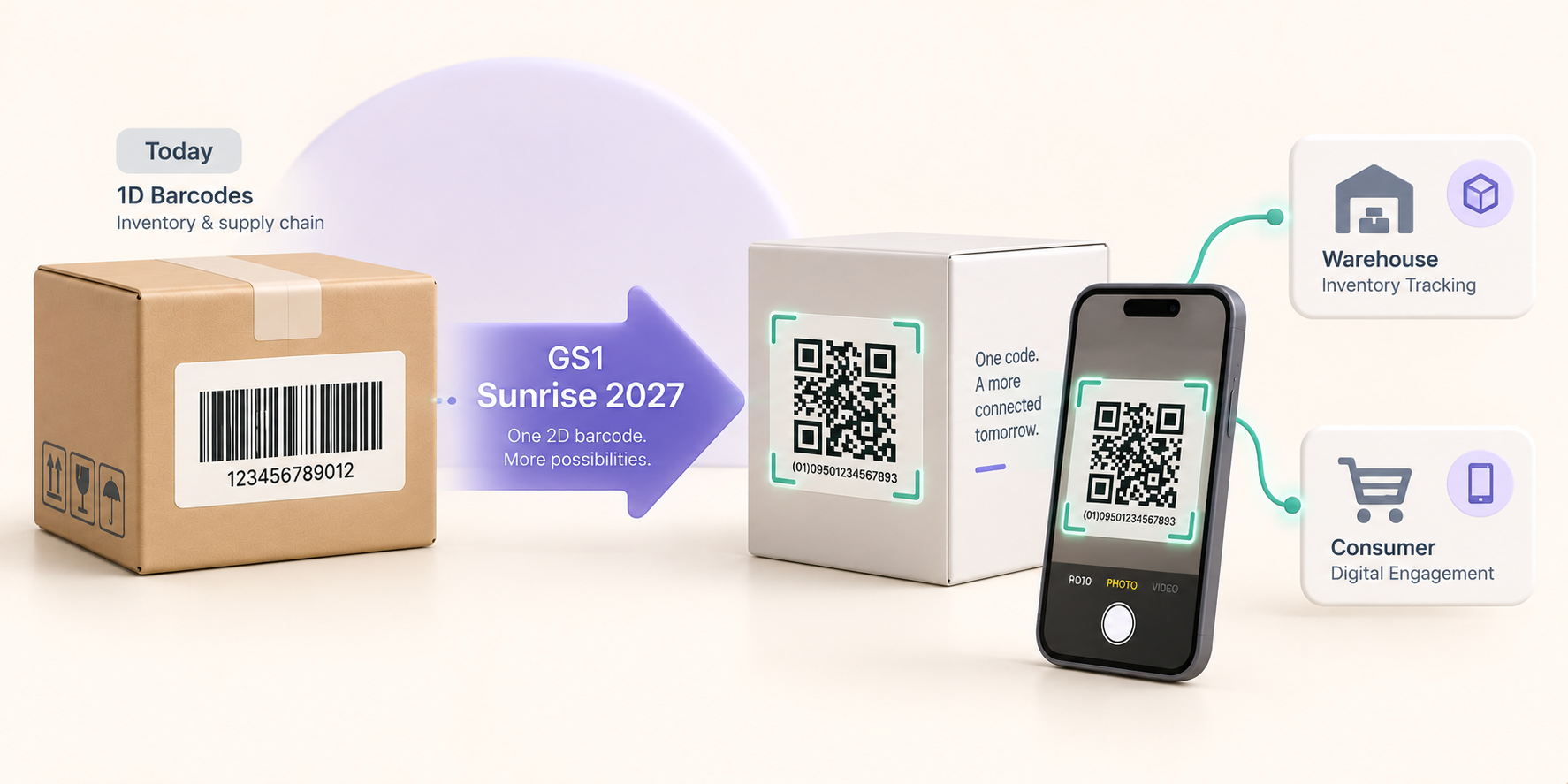
Sunrise 2027 is the name the global retail industry gives to a coordinated upgrade: point-of-sale (POS) systems should be able to scan and process 2D barcodes — GS1 DataMatrix and QR Code with GS1 Digital Link — by the end of 2027. GS1 US reports that the transition is already being tested in 48 countries. It is a capability deadline for retailers, and a packaging and data deadline for the brands that supply them.
What Sunrise 2027 actually commits to
The commitment is narrower than the headlines suggest. Sunrise 2027 does not require any product to carry a 2D barcode. It requires the checkout infrastructure to be ready: POS scanners that image 2D symbols, and POS software that can process the richer data those symbols return. A till that can read a QR code but treats it as an error has not made the transition.
The reason for the program is the limit of the 1D model. An EAN/UPC scan returns a GTIN and nothing else; expiry dates, batches, and serials — the data needed for targeted recalls, expiry-based stock rotation, and product authentication — cannot travel through a price-lookup symbol. A 2D symbol read at the same till can return all of it.
One code, three audiences
The strategic prize is consolidation. Today a pack may carry an EAN for the till, a separate QR code for marketing, and internal codes for logistics. A QR Code encoded with GS1 Digital Link holds a web address built on the GTIN, so the same symbol resolves differently by context: the till extracts the product identity, supply-chain systems read the identifiers, and a shopper’s phone opens the brand’s product page. One printed symbol, three audiences.
What does not change
Three reassurances matter for planning. First, GTINs do not change: the same product keeps the same identifier, expressed inside the 2D symbol. Second, 1D barcodes are not banned or withdrawn — EAN/UPC remains valid, and during the transition many packs will carry both symbols (dual marking). Third, nothing happens automatically at the deadline for products: 2027 readiness is a property of retail systems first, and brand packaging programs follow their customers’ timelines.
A practical preparation checklist
For manufacturers and distributors, preparation is mostly audit work before it is artwork work.
- Scanner audit: confirm which of your own and your retail customers’ scanners are imaging models that read DataMatrix and QR Code.
- Data audit: the 2D symbol can only carry batch, expiry, and serial data if your master data and packaging processes produce it reliably.
- Artwork planning: reserve label space and quiet zones for a second symbol during dual marking; verify print quality at production speed, not on a proof.
- Pilot: run one product line through a 2D pilot with a cooperative retail partner before committing the range.
- POS systems read 2D barcodes by end of 2027
- GTINs do not change
- 1D barcodes are not banned or withdrawn
- Dual marking (1D + 2D) is the normal transition
- Scanner audit: imaging models that read DataMatrix and QR Code
- Data audit: batch, expiry, and serial data produced reliably
- Artwork planning: label space and quiet zones for a second symbol
- Pilot one product line with a cooperative retail partner
Comments
Comments are stored in this browser only. They are not published, synced, or visible to other readers.
No comments yet on this device. Be the first.