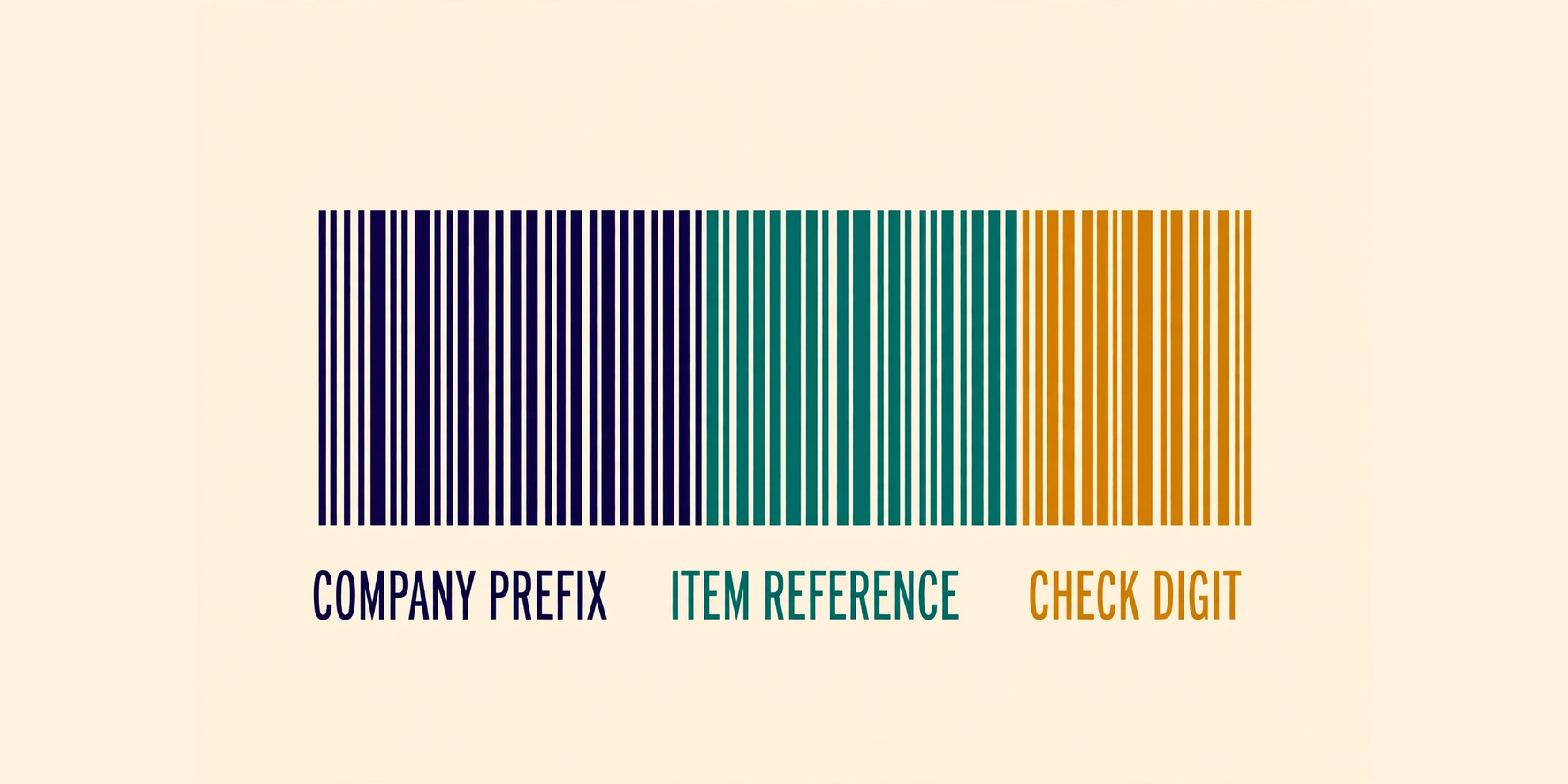
Ask what a barcode "means" and the honest answer is usually a number: the GTIN, the Global Trade Item Number. It is the identity that every other barcode concept hangs from — the lookup key in a till, the product in a recall, the item on an order. Yet it is also one of the most misunderstood numbers in the supply chain, routinely confused with prices, SKUs, and serial numbers.
This article separates those ideas. A GTIN identifies a product (or a packaging level of a product). It does not price it, it does not track an individual unit, and it is not something a software vendor can invent for you.
What a GTIN is — and is not
A GTIN is a globally unique identifier for a trade item: a specific product in a specific packaging configuration, from a specific brand owner. "Globally unique" is doing real work here: the same GTIN must never identify two different products, anywhere in the world, and the same product must keep the same GTIN across every retailer and system that handles it.
What a GTIN is not matters just as much. It is not a price — prices live in retail systems keyed by GTIN, but the number itself carries no price. It is not a serial number — every unit of the same product shares its GTIN, which is why serialization adds batch and serial fields alongside it. And it is not an internal code: a SKU identifies a product inside one company’s systems, while a GTIN identifies it everywhere. Substituting a SKU where a GTIN belongs works until the product meets a partner’s system — and then it fails completely.
One identity, four lengths
GTINs come in four lengths — 8, 12, 13, and 14 digits — and the lengths are views of the same identity system, not four different schemes. GTIN-12 is the familiar UPC used in North America; GTIN-13 is the EAN used across most of the rest of the world; GTIN-8 is for very small items where a longer symbol physically will not fit; GTIN-14 identifies a packaging level, such as a case, built on the GTIN of the items inside it.
Every length ends with the same mechanism: a check digit computed from the preceding digits with the GS1 Modulo-10 algorithm, which is why a GTIN can be validated the moment it is scanned, before any database is consulted. The arithmetic is covered in full in the check-digit article; the point here is structural — whatever the length, the last digit is a guard, not an identifier.
Schematic, not to scale: segment widths do not encode lengths.
Who allocates GTINs
GTINs are allocated by the brand owner of the product, through a GS1 member organisation (such as GS1 US) that issues the company prefix — the leading digits that make the GTIN globally unique to that owner. The brand owner then assigns item references within its prefix and computes the check digit. This is why no software vendor, scanner manufacturer, or marketplace can issue you a GTIN: the number’s authority comes from the allocation, not from the printing.
Vision Scan follows the same rule, stated plainly in its own footer: GS1 Company Prefixes, GTINs, and UDI identifiers must be officially licensed through authorized GS1 member bodies, and Vision Scan does not allocate GTIN numbers. Any tool that offers to invent a GTIN for you is offering a number that will collide with somebody else’s product.
When a product needs a new GTIN
The rule of thumb is identity: when a change makes the product distinguishable in a way a trading partner must act on, it needs a new GTIN. A new formulation, a different net content, a new packaging configuration that changes how the product is ordered or sold — each creates a distinct trade item, and giving it the old number would silently merge two products in every system downstream.
Conversely, changes that do not affect identity — a artwork refresh, a supplier change behind the same specification — do not need a new GTIN. The discipline is to ask, for every change, "would a retailer, a regulator, or a recall need to tell these apart?" If the answer is yes, allocate; if no, keep the number. GTIN discipline is mostly the discipline of not creating identities carelessly — neither duplicating them nor multiplying them.
Comments
Comments are stored in this browser only. They are not published, synced, or visible to other readers.
No comments yet on this device. Be the first.